Pelvic Curl
You lie on your back and peel your spine off the mat one section at a time, then lower it back down. It wakes up the back of the legs and teaches your spine to move in small, controlled pieces.
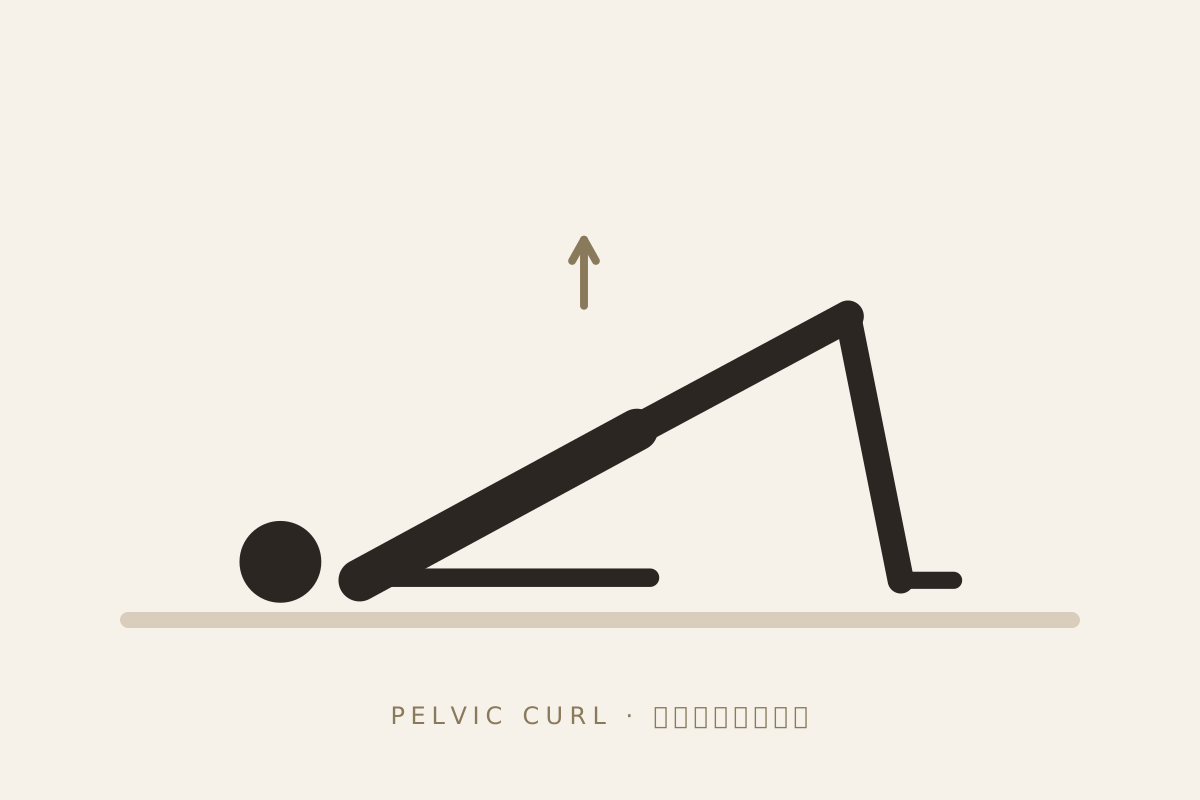
Illustration. Kiki's own photos are coming soon.
What it works
- Glutes (seat muscles)
- Hamstrings (back of the thighs)
- Deep abdominals
- Mobility through the spine
Starting position
Lie on your back with knees bent and feet flat on the mat, hip-width apart and parallel. Rest your arms long by your sides, palms down. Let your pelvis and spine settle in neutral: a small natural curve stays under your lower back.
How to do it
- Breathe in to prepare and feel your feet press evenly into the mat.
- Breathe out and tip your tailbone gently up toward the ceiling, so your lower back moves toward the mat.
- Keep breathing out as you lift your hips and then your back, one section at a time, until your weight rests between your shoulder blades.
- Breathe in and hold, with a long line from knees to shoulders. Keep your ribs soft, not flared.
- Breathe out and lower from the top of your back down, one section at a time, until your tailbone touches down last.
- Let your pelvis return to neutral before the next rep.
Breathing
Breathe in to prepare, out to roll up, in at the top, out to roll down.
How many
3–5 slow reps
Teaching cues
- Imagine your spine is a string of pearls lifting off the floor one pearl at a time.
- Keep your knees pointing straight ahead, like headlights.
- Lift only as high as you can while your ribs stay soft.
Common mistakes
Make it easier
Make it smaller: just tilt the pelvis and lift the hips a few inches, then lower.
Make it harder
At the top, hold and add a slow knee-fold: lift one foot an inch off the mat and set it down without letting the hips drop or tilt, then switch.
Before you start
Osteoporosis or low bone density: UK guidance advises avoiding repeated or end-range bending of the spine. Instead of rolling up bone by bone, lift and lower your hips with your back kept long and straight (a simple bridge). Pregnant: ACOG notes that lying flat on your back for long stretches after about 20 weeks can lower blood flow back to the heart and drop blood pressure. Keep supine sets short, prop your upper body on pillows or a wedge, and stop if you feel dizzy or unwell. Ask your doctor or midwife what suits you. Back or neck pain: keep the lift small and stop if pain increases. Check with your doctor or physical therapist if you have a spinal condition, recent surgery, or pain that does not settle.
This page is general guidance for healthy adults, not medical advice. Stop if anything hurts, and check with your doctor or physical therapist if you have an injury, a medical condition, or are pregnant or postpartum.
Questions
Is the pelvic curl the same as a glute bridge?
They look alike. A glute bridge usually lifts the hips with the back held straight. The pelvic curl rolls the spine up and down one section at a time, so it trains spine control as well as the seat muscles.
Can this help my lower back pain?
A Cochrane review found low- to moderate-quality evidence that Pilates reduces pain in non-specific low back pain compared with doing very little, but not clear evidence it beats other exercise. Keep the movement small and pain-free, and see a doctor or physical therapist if your pain is new, severe, or spreading down a leg.
Try next
Sources
- Merrithew (STOTT PILATES) – Essential Mat Workout guide (PDF)
- Brooke-Wavell et al. 2022, "Strong, steady and straight": UK consensus on physical activity and exercise for osteoporosis (full text)
- ACOG Committee Opinion No. 804: Physical Activity and Exercise During Pregnancy and the Postpartum Period (2020)
- Yamato et al. 2015, Pilates for low back pain (Cochrane review, PubMed)
Want feedback on your form?
Practice at home works best with a teacher checking your form. Join the Friday mat class in Point Loma, or book a one-on-one online session with Kiki.