Cat Stretch
On hands and knees, you round your back one section at a time, then lengthen it back to a flat, neutral spine. It wakes up the spine and teaches you to move it piece by piece instead of all at once.
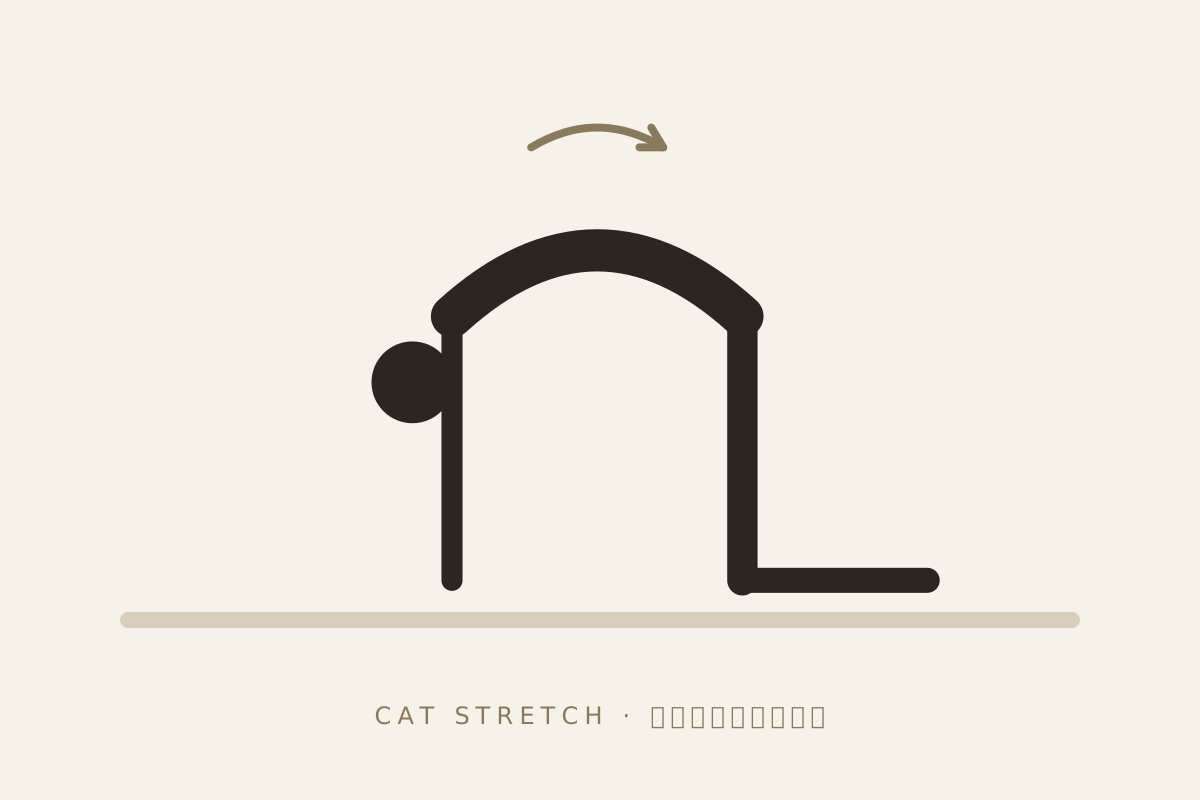
Illustration. Kiki's own photos are coming soon.
What it works
- Flexibility of the whole spine
- Deep abdominals, which do the rounding
- Shoulder blade and arm support
- Coordination of breath and movement
Starting position
Come onto hands and knees. Hands under shoulders, knees under hips and hip-width apart. Your back is long and flat with its natural gentle curves, and the back of your neck is long, eyes looking at the mat.
How to do it
- Breathe in to prepare.
- Breathe out and begin the curve at your tailbone: tuck it under, then let the rounding travel up your lower back, middle back and upper back, and finally let your head drop.
- Breathe in and stay in the rounded shape, feeling the back widen.
- Breathe out and lengthen back to a flat back in the same order, tailbone first and head last.
- Pause in neutral before the next rep.
Breathing
Breathe out to round, breathe in to hold, breathe out to return to neutral.
How many
3 to 5 slow reps.
Teaching cues
- Move one bone at a time, like a string of pearls.
- Push the floor away to fill the space between your shoulder blades.
- Let your belly lift the curve; don't just drop your head.
Common mistakes
Make it easier
Make the movement smaller and focus only on tucking and untucking the tailbone. If kneeling is uncomfortable, do the same rounding while sitting tall on a chair with your hands on your thighs.
Make it harder
Slow it down so each section of the spine gets its own count, and hold the rounded shape for a few breaths while keeping the shoulders steady.
Before you start
If you have osteoporosis or osteopenia, ask your doctor or physical therapist before doing the rounding part. UK expert consensus advises modifying or avoiding sustained, repeated or end-range rounding of the spine; a safe adaptation is to keep the curve small or practice only the return to a long, flat back. Use a folded towel under sore knees, and make fists or use the edge of the mat if your wrists hurt. Hands and knees is often a comfortable position during pregnancy, but follow your ob-gyn's advice. Check with your doctor or physical therapist if you have a disc problem or back or neck pain that rounding makes worse.
This page is general guidance for healthy adults, not medical advice. Stop if anything hurts, and check with your doctor or physical therapist if you have an injury, a medical condition, or are pregnant or postpartum.
Questions
Is Cat Stretch the same as yoga's cat-cow?
They are related. Cat-cow usually moves between a rounded back and an arched back. Pilates Cat Stretch rounds the spine and then returns to a long, neutral back, with the focus on moving one section at a time.
Will Cat Stretch help my lower back pain?
It may feel good, but no single exercise is proven to fix back pain. A Cochrane review found low- to moderate-quality evidence that Pilates reduces back pain compared with doing very little, but no clear advantage over other forms of exercise. If you have back pain, a doctor or physical therapist can help you choose what to do.
Try next
Sources
- STOTT PILATES Matwork exercise guide (Merrithew) — Swimming Prep, Spine Twist, Cat Stretch
- Brooke-Wavell et al. 2022, "Strong, steady and straight": UK consensus on physical activity and exercise for osteoporosis (full text)
- Yamato et al. 2015, Pilates for low back pain (Cochrane review, PubMed)
- ACOG patient FAQ: Exercise During Pregnancy
Want feedback on your form?
Practice at home works best with a teacher checking your form. Join the Friday mat class in Point Loma, or book a one-on-one online session with Kiki.