Single Leg Stretch
With your head and shoulders curled up, you switch legs: one knee bends in while the other reaches out long. It trains your abdominals to keep the pelvis and trunk still while the legs move.
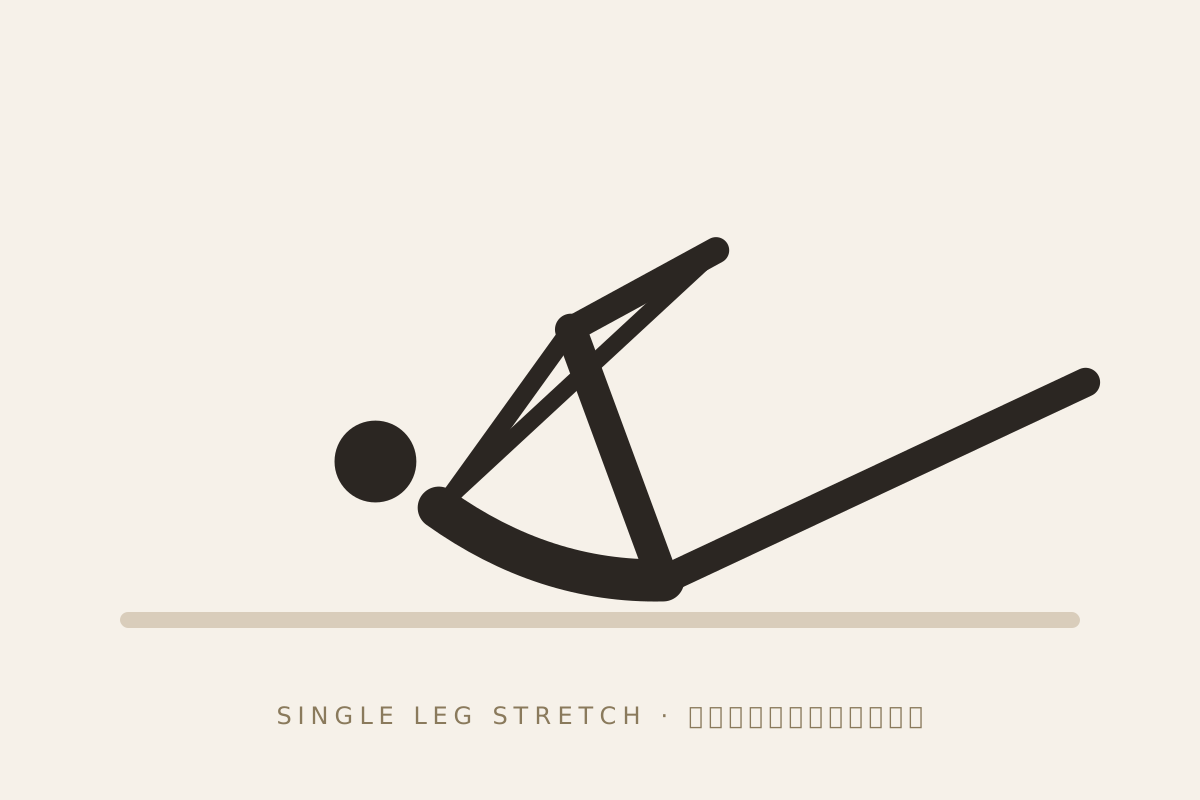
Illustration. Kiki's own photos are coming soon.
What it works
- Abdominals
- Pelvic stability
- Hip flexors (front of the hips)
- Coordination of breath and movement
Starting position
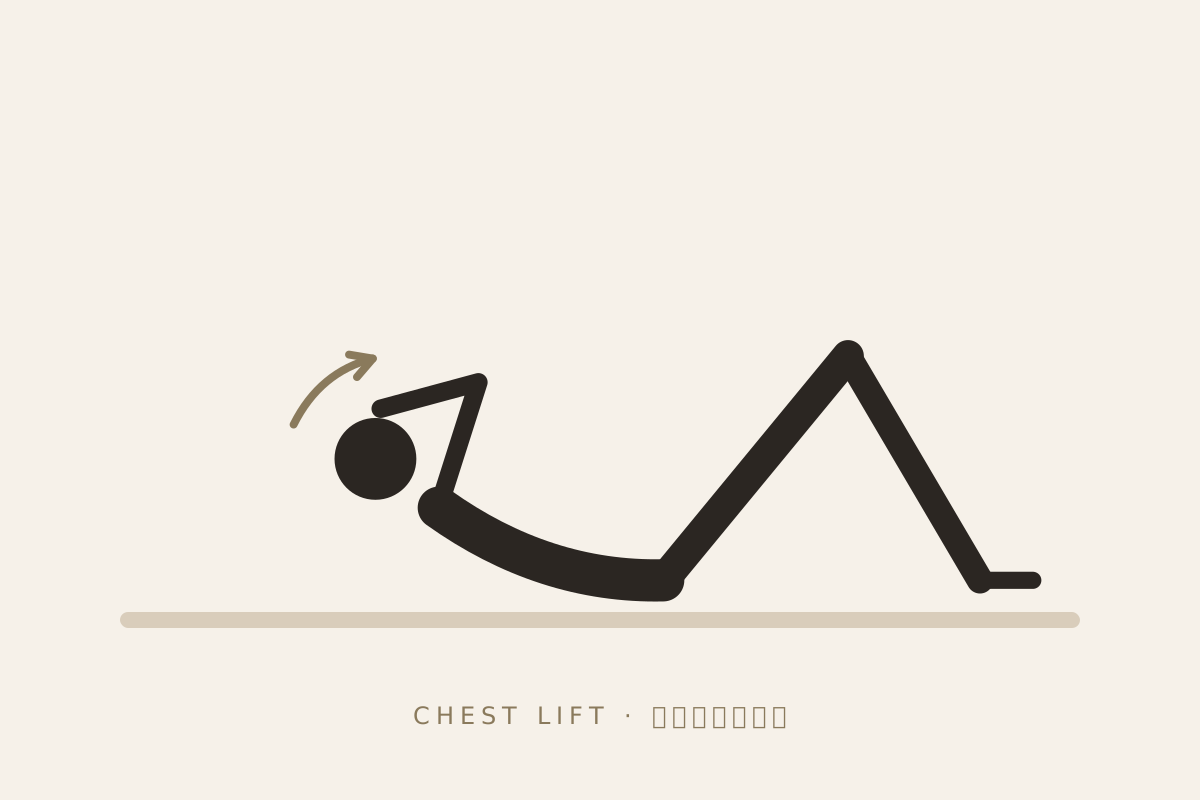
Lie on your back and lift both legs into tabletop: knees over hips, shins parallel to the floor. Gently draw your lower back toward the mat (an imprinted position). Curl your head and shoulders up as in the Chest Lift and rest your hands on the outside of your knees.
How to do it
- Breathe in to prepare, keeping your upper body curled.
- Breathe out and reach your right leg out on a diagonal. Your left knee stays bent; place your left hand on your left ankle and your right hand on your left knee.
- Breathe in as you begin to switch legs, passing through tabletop.
- Breathe out and reach the left leg long while the right knee bends in. Change hands: right hand to right ankle, left hand to right knee.
- Keep alternating, keeping the pelvis level and the upper body lifted.
Breathing
Breathe out as one leg reaches long, in as you switch.
How many
8–10 per leg
Teaching cues
- Reach the straight leg long, as if someone is gently pulling your foot away.
- Your pelvis is a bowl of water. Don't spill it as your legs switch.
- Lower the straight leg only as far as your back stays steady.
Common mistakes
Make it easier
Keep your head down on the mat with a small pillow under it, and only switch the legs. Or reach the straight leg higher toward the ceiling.
Make it harder
Lower the reaching leg closer to the mat while the back stays steady, and keep a steady rhythm.
Before you start
Osteoporosis or low bone density: this holds the spine bent forward, which UK osteoporosis guidance advises avoiding or modifying. Keep your head down on the mat or skip it unless your doctor or physical therapist approves. Pregnant: ACOG notes that lying flat on your back for long stretches after about 20 weeks can lower blood flow back to the heart and drop blood pressure. Keep supine sets short, prop your upper body on pillows or a wedge, and stop if you feel dizzy or unwell. Ask your doctor or midwife what suits you. Neck pain: keep your head down. Low back pain: keep the legs high, or bend both knees and tap one foot down at a time instead. Check with your doctor or physical therapist if you have hip or back pain during the movement.
This page is general guidance for healthy adults, not medical advice. Stop if anything hurts, and check with your doctor or physical therapist if you have an injury, a medical condition, or are pregnant or postpartum.
Questions
Where do my hands go?
On the bent leg: the hand on the same side holds the ankle and the other hand holds the knee. This lines the knee up with the hip. If it feels awkward, simply rest both hands on the bent knee.
I feel it in the front of my hips more than my abs. Why?
Your hip flexors may be taking over, often because the straight leg is too low. Raise the leg higher and draw your belly gently in as you breathe out.
Try next
Sources
- Merrithew (STOTT PILATES) – Essential Mat Workout guide (PDF)
- Brooke-Wavell et al. 2022, "Strong, steady and straight": UK consensus on physical activity and exercise for osteoporosis (full text)
- ACOG Committee Opinion No. 804: Physical Activity and Exercise During Pregnancy and the Postpartum Period (2020)
Want feedback on your form?
Practice at home works best with a teacher checking your form. Join the Friday mat class in Point Loma, or book a one-on-one online session with Kiki.