The Hundred
You hold a chest-lift position and pump your arms while breathing in for five counts and out for five, ten times through: one hundred pumps. It warms up the body and trains your abdominals to hold steady while you breathe.
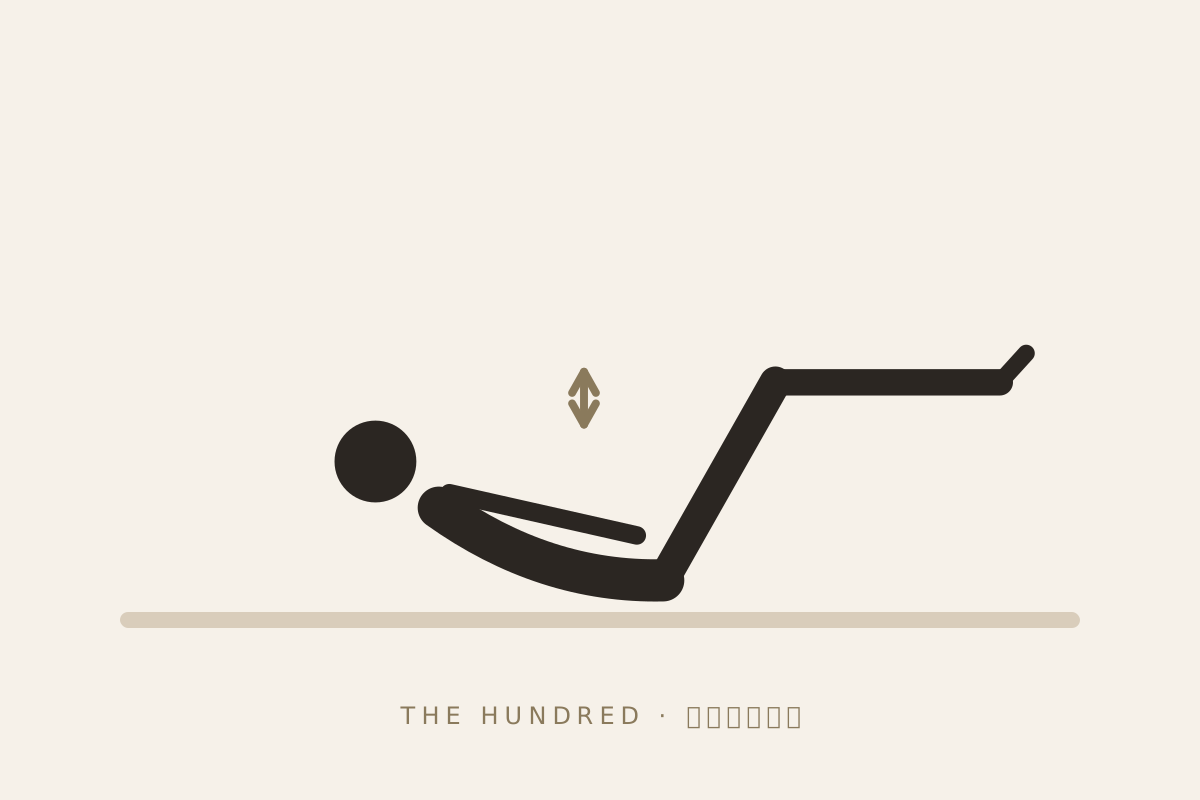
Illustration. Kiki's own photos are coming soon.
What it works
- Abdominals (holding power)
- Breath control
- Shoulder stability
- Circulation, as a warm-up
Starting position
Lie on your back. Beginners: bend your knees with feet flat on the mat, or lift your legs into tabletop (knees over hips, shins parallel to the floor). Arms rest long by your sides, palms down.
How to do it
- Breathe in to prepare.
- Breathe out and curl your head and shoulders off the mat, as in the Chest Lift. Reach your arms forward a few inches above the mat.
- Pump your arms up and down in a small, quick motion from the shoulders, keeping the arms straight.
- Breathe in for five pumps, then out for five pumps. That is one set of ten.
- Repeat for up to ten sets (100 pumps), keeping your curl steady.
- When you finish, bring your knees in, if lifted, and lower your head to rest.
Breathing
In for five pumps, out for five pumps.
How many
Build up to 100 pumps (10 sets); start with 50
Teaching cues
- The pump is small, about the height of your hand, and comes from the shoulder, not the wrist.
- Keep your upper body still while only the arms move.
- Breathe out longer and fuller than feels natural.
Common mistakes
Make it easier
Keep your feet on the mat and your head down, and do only the arm pumps with the breathing. Or curl up for one set, rest, and repeat.
Make it harder
From tabletop, straighten your legs toward the ceiling, then lower them only as far as your lower back stays steady.
Before you start
Osteoporosis or low bone density: this holds the spine bent forward, which UK osteoporosis guidance advises avoiding or modifying. Do the arm pumps and breathing with your head down instead, or skip it unless your doctor or physical therapist approves. Pregnant: ACOG notes that lying flat on your back for long stretches after about 20 weeks can lower blood flow back to the heart and drop blood pressure. Keep supine sets short, prop your upper body on pillows or a wedge, and stop if you feel dizzy or unwell. Ask your doctor or midwife what suits you. Neck pain: keep your head down on the mat. Low back pain: keep your feet on the mat. Check with your doctor or physical therapist if you have a heart or blood pressure condition, a disc problem, or pain during the exercise.
This page is general guidance for healthy adults, not medical advice. Stop if anything hurts, and check with your doctor or physical therapist if you have an injury, a medical condition, or are pregnant or postpartum.
Questions
Why is it called the Hundred?
Because you count to one hundred: ten breaths, each made of five arm pumps in and five out. It appears in Joseph Pilates' 1945 book Return to Life Through Contrology.
I can't do all 100 yet. Is that okay?
Yes. Do as many sets as you can with good form, rest your head between sets, and add a set as you get stronger.
Try next
Sources
- Balanced Body, The CORE – "It All Starts with The Hundred" (quotes Return to Life, 1945)
- Brooke-Wavell et al. 2022, "Strong, steady and straight": UK consensus on physical activity and exercise for osteoporosis (full text)
- ACOG Committee Opinion No. 804: Physical Activity and Exercise During Pregnancy and the Postpartum Period (2020)
Want feedback on your form?
Practice at home works best with a teacher checking your form. Join the Friday mat class in Point Loma, or book a one-on-one online session with Kiki.