Spine Twist
Sitting tall, you turn your upper body to one side and back to center while your pelvis stays still. It keeps your spine moving in rotation and trains you to twist from your middle, not your lower back.
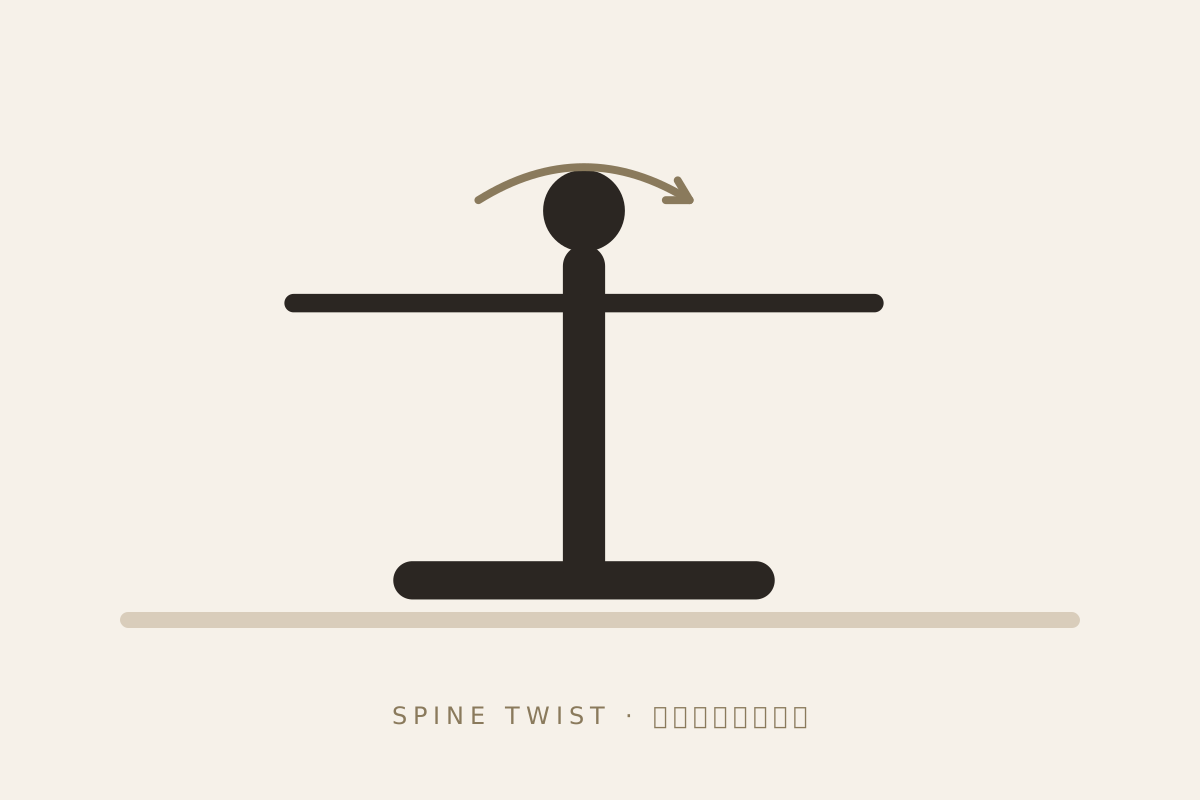
Illustration. Kiki's own photos are coming soon.
What it works
- Rotation through the upper and middle back
- Oblique (side) abdominal muscles
- Back muscles that hold you upright
- Posture awareness while sitting
Starting position
Sit on your mat with your legs crossed, or with legs straight out in front and feet flexed if your hamstrings allow it. Sit on the top of your sitting bones with your spine tall. If your lower back rounds, sit on a folded blanket or cushion. Cross your forearms in front of your chest at shoulder height, or reach your arms out to the sides.
How to do it
- Breathe in and grow taller, as if a string lifts the top of your head.
- Breathe out and turn your ribs and head to one side in two or three small steps, going a little further each time.
- Keep both sitting bones heavy on the mat and your nose in line with your breastbone.
- Breathe in and turn back to center, staying just as tall.
- Repeat to the other side and keep alternating.
Breathing
Breathe out as you turn in small steps, breathe in as you return to center.
How many
3 to 5 reps each side, alternating.
Teaching cues
- Grow taller before you turn.
- Turn like a spiral staircase, around a tall center.
- Your hips are glued; your ribs do the turning.
Common mistakes
Make it easier
Sit cross-legged on a cushion, or sit on a sturdy chair with your feet flat, and place your hands on your shoulders.
Make it harder
Sit with legs straight and together, feet flexed, arms reaching wide to the sides, and keep the arms in one long line as you turn.
Before you start
Turn only as far as is comfortable; never force the end of the twist. For people with osteoporosis, UK expert consensus says twisting movements should be safe when done smoothly and comfortably, and advises against slumped, rounded postures, so sit tall (on a cushion if needed) rather than letting your back curl. Check with your doctor or physical therapist if you have a disc problem, a known spinal fracture, back or neck pain that a twist makes worse, or pain that lasts after exercise. If you are pregnant, follow your ob-gyn's advice.
This page is general guidance for healthy adults, not medical advice. Stop if anything hurts, and check with your doctor or physical therapist if you have an injury, a medical condition, or are pregnant or postpartum.
Questions
Can I do Spine Twist in a chair?
Yes. Sit near the front of a sturdy chair with both feet flat and your back away from the backrest. The same rules apply: grow tall first, keep both hips still, and turn from the ribs.
Why can't I sit up straight with my legs out in front?
Tight hamstrings (the muscles at the back of the thigh) pull the pelvis back and round the lower back. Sit on a folded blanket, bend your knees, or cross your legs. Sitting tall matters more than straight legs.
Try next
Sources
Want feedback on your form?
Practice at home works best with a teacher checking your form. Join the Friday mat class in Point Loma, or book a one-on-one online session with Kiki.