Swan Prep
Lying face down, you lift your head and chest off the mat using the muscles along your back, then lower with control. It strengthens the back, opens the front of the chest, and balances all the forward-curling exercises.
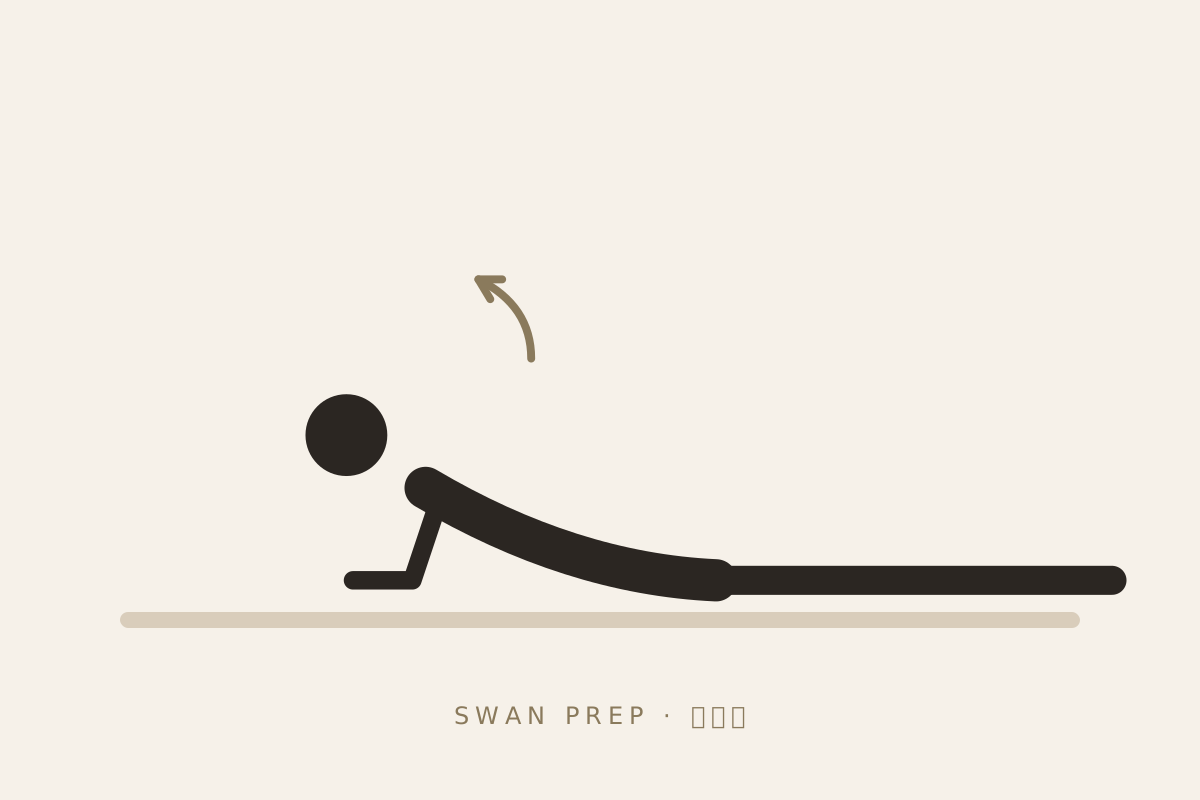
Illustration. Kiki's own photos are coming soon.
What it works
- Muscles along the spine
- Upper back and shoulder-blade control
- Opening the chest and front of the shoulders
- Buttock and abdominal support for the lower back
Starting position
Lie on your stomach with your forehead resting on the mat or a small folded towel. Place your hands on the mat near your shoulders, elbows bent and close to your sides. Your legs are long, about hip-width apart. Gently draw your belly away from the mat so your lower back feels supported.
How to do it
- Breathe in to prepare, sliding your shoulder blades down your back.
- Breathe out and lengthen through the crown of your head as you lift your head and then your chest off the mat. Use your back muscles first and press only lightly into your hands.
- Keep your gaze down and slightly forward so your neck stays long, and keep your lower ribs close to the mat.
- Breathe in and hold the lift for a moment.
- Breathe out and lower slowly, chest first and then forehead, staying long through the spine.
Breathing
Breathe in to prepare, breathe out to lift; breathe in to hold, breathe out to lower.
How many
5–8 slow reps
Teaching cues
- Lift long and forward, not high and back.
- Let your back do the work; your hands just steady you.
- Keep your neck long, like it is following your spine.
Common mistakes
Make it easier
Lift only your head and the top of your chest a few inches, or rest on your forearms with elbows under your shoulders and simply lengthen forward.
Make it harder
Lift a little higher by gradually straightening your arms, while your pubic bone stays down and your lower back stays comfortable. The full rocking Swan Dive is an advanced exercise; learn it with an instructor rather than at home.
Before you start
Gentle back-extension work like this is generally encouraged for people with osteoporosis; a UK consensus statement recommends spinal extension exercise. If you have had a vertebral fracture, get guidance from a physical therapist first. Keep the lift small or skip it if bending backward causes lower back pain, for example with spinal stenosis. During pregnancy, lying face down becomes uncomfortable as your belly grows; ask your provider about an alternative, such as working on hands and knees. Check with your doctor or physical therapist if you have back or neck pain.
This page is general guidance for healthy adults, not medical advice. Stop if anything hurts, and check with your doctor or physical therapist if you have an injury, a medical condition, or are pregnant or postpartum.
Questions
I feel Swan in my lower back. Is that wrong?
Mild muscle work along the back is expected, but a pinching feeling in the lower back usually means you are lifting too high or pushing too hard with your arms. Lift lower, press less with your hands, and draw your belly in. If it still pinches, stop.
Why do Pilates sessions include back exercises like Swan?
Many mat exercises curl the spine forward. Swan works the opposite direction, strengthening the back and opening the chest, which helps balance the session and supports upright posture.
Try next
Sources
- Merrithew (STOTT PILATES) Matwork exercise sheet — Swan Dive Prep
- Brooke-Wavell et al. 2022, "Strong, steady and straight": UK consensus on physical activity and exercise for osteoporosis (full text)
- Balanced Body Contrology Journal: Mat Is the Method — Pilates Exercise Is a System
- ACOG patient FAQ: Exercise During Pregnancy (FAQ119, reviewed Nov 2025)
Want feedback on your form?
Practice at home works best with a teacher checking your form. Join the Friday mat class in Point Loma, or book a one-on-one online session with Kiki.